


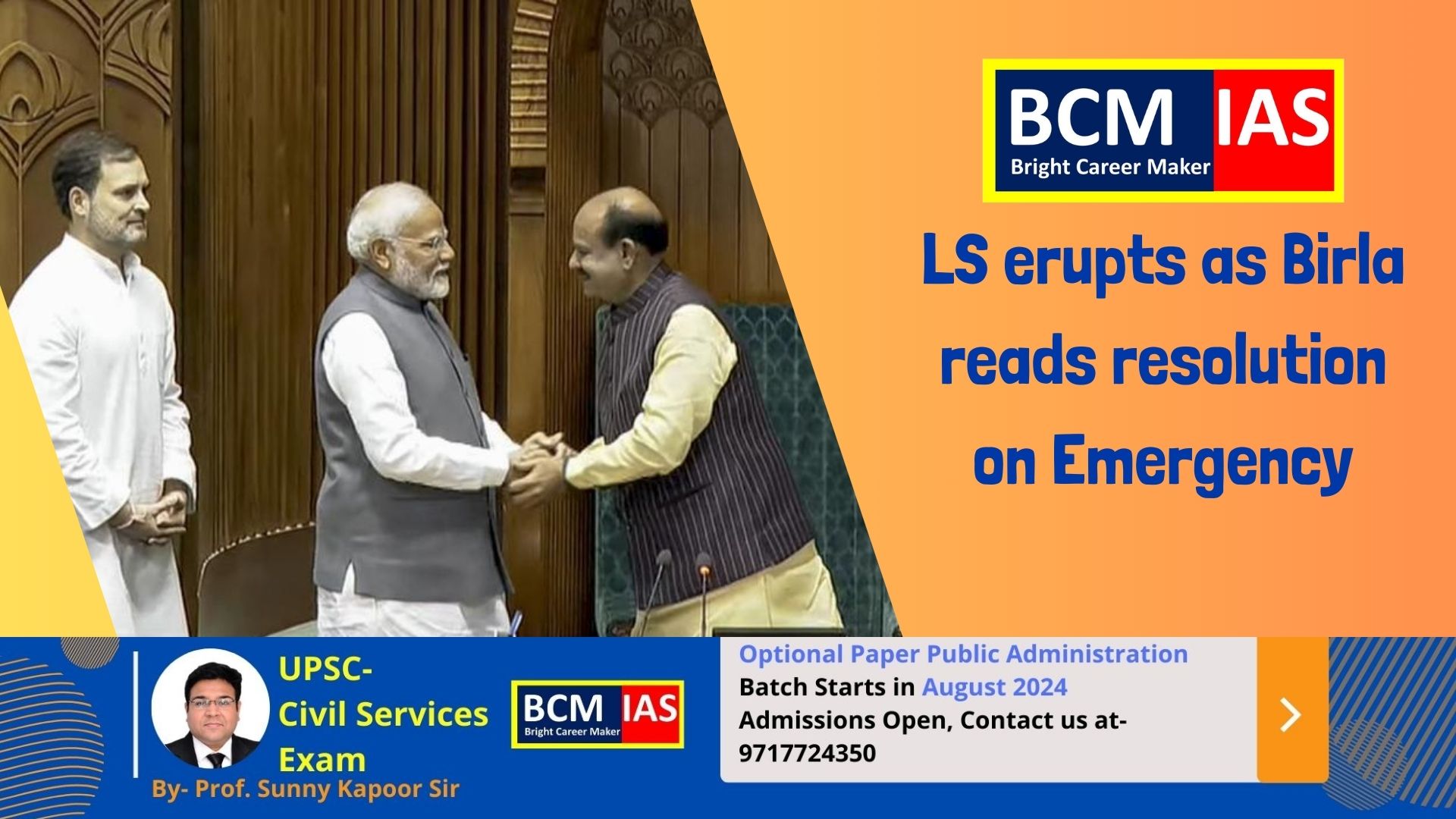
"LS erupts as Birla reads
resolution on Emergency"
Analysis and Explanation
of the News
Introduction
·
The news article titled "LS erupts as Birla reads
resolution on Emergency" discusses the recent tumultuous events in the Lok
Sabha following the reading of a resolution on the 1975 Emergency by Om Birla,
the newly elected Speaker.
·
The article highlights the breakdown of the initial
bonhomie post his election and the subsequent protests by the Opposition.
Context of the Emergency Resolution
- Historical
Background: The
1975 Emergency in India, declared by then-Prime Minister Indira Gandhi, is
a significant event in the country’s political history. It involved the
suspension of constitutional rights and the imposition of stringent
measures to control political opposition and civil liberties.
- Purpose
of the Resolution: The resolution read by Speaker Om Birla emphasized the oppressive
nature of the Emergency, accusing the Congress party of undermining the
Constitution and democracy. Birla cited the concentration of power and the
suppression of citizens' rights as central critiques.
Political Reactions and Parliamentary Dynamics
- Opposition's
Protest: The
reading of the resolution triggered protests from the Opposition members,
leading to a chaotic situation in the House. The Opposition accused the
ruling party of using the resolution as a political tool to silence
dissent and divert attention from contemporary issues.
- Congress's
Stance:
Congress leaders, including Jairam Ramesh, contended that they did not
seek a division of votes on the Speaker’s election to foster a
consensus-driven atmosphere. However, the reading of the resolution
reignited historical grievances and accusations.
Key Political Figures and Their Statements
- Prime
Minister Narendra Modi: After Om Birla’s election, Modi praised Birla for maintaining the
decorum of the House during his previous term and expressed confidence in
his impartiality.
- Rahul
Gandhi: The
Leader of the Opposition highlighted the need for the Speaker to ensure
that the Opposition's voice is heard in the House, emphasizing the
importance of impartiality in parliamentary proceedings.
- Other
Political Leaders: Leaders from various parties, including the Samajwadi Party and
the Trinamool Congress, expressed concerns about the Speaker's
impartiality and the treatment of Opposition MPs.
Outcome of the Proceedings
- Adjournment
of the House:
Amid the uproar and slogan-shouting by Opposition members, the House was
adjourned after observing a moment of silence for the victims of the
Emergency.
- Political
Implications:
The incident underscores the persistent tensions between the ruling party and
the Opposition, highlighting the challenges of maintaining parliamentary
decorum and fostering a collaborative legislative environment.
Conclusion
The episode in the Lok Sabha, triggered by the reading of the
Emergency resolution, reflects the deep-seated political divides and the
contentious nature of India's parliamentary proceedings. While the initial
election of Om Birla as Speaker was marked by a rare moment of unity, the
subsequent events reveal the enduring complexities and confrontations that
characterize Indian politics. The incident serves as a reminder of the
importance of upholding democratic principles and ensuring that parliamentary platforms
are used constructively to address the nation’s pressing issues.
Mains Practice Question
Discuss the significance of the 1975 Emergency
in Indian history and its impact on contemporary Indian politics. How do recent
parliamentary events, such as the reading of the Emergency resolution by
Speaker Om Birla, reflect the enduring legacy of the Emergency?
Answer:
Introduction
The 1975 Emergency is one of the most critical and
controversial periods in Indian political history. Declared by then-Prime
Minister Indira Gandhi, the Emergency lasted from June 25, 1975, to March 21,
1977. It involved the suspension of constitutional rights, censorship of the
press, and widespread arrests of political opponents. The recent reading of a
resolution on the Emergency by Speaker Om Birla in the Lok Sabha underscores
the lasting impact of this period on India's political discourse.
Significance of the 1975 Emergency
1.
Erosion of Democratic Norms:
o The Emergency
saw the curtailment of civil liberties and the undermining of democratic
institutions.
o Fundamental
rights, including freedom of speech and expression, were suspended, and the
press was heavily censored.
o Political
opponents and activists were arrested without trial under preventive detention
laws.
2.
Centralization of Power:
o The period was
marked by the concentration of power in the hands of the Prime Minister and her
close advisors.
o The government
bypassed parliamentary procedures and used ordinances to rule by decree.
3.
Judicial Independence:
o The judiciary
faced significant pressure and interference, leading to concerns about its
independence.
o The infamous ADM
Jabalpur case (Habeas Corpus case) saw the Supreme Court ruling in favor of the
government's right to suspend habeas corpus during the Emergency.
4.
Political Repercussions:
o The Emergency
led to widespread public discontent and a significant backlash against the
Congress party.
o The 1977 general
elections saw the Congress party's defeat and the rise of the Janata Party,
marking the first time an opposition party came to power at the center.
Impact on Contemporary Indian Politics
1.
Legacy of Distrust:
o The Emergency
has left a legacy of distrust towards any perceived overreach of executive
power.
o Political
discourse often references the Emergency when debating issues related to civil
liberties and democratic governance.
2.
Strengthening of Democratic Institutions:
o The experience
of the Emergency has led to a stronger emphasis on safeguarding democratic
institutions and ensuring checks and balances.
o Subsequent
governments have been more cautious about imposing restrictions on fundamental
rights.
3.
Political Rhetoric:
o The Emergency is
frequently invoked in political rhetoric to criticize opponents and highlight
the importance of democratic values.
o The recent
reading of the Emergency resolution by Speaker Om Birla is an example of how
historical events are used to frame contemporary political narratives.
Recent Parliamentary Events and the Enduring
Legacy
1.
Reading of the Emergency Resolution:
o Speaker Om
Birla's reading of the resolution on the 1975 Emergency triggered significant
protests from the Opposition.
o The resolution
criticized the Congress party for imposing the Emergency and undermining the
Constitution and democratic principles.
2.
Opposition's Reaction:
o Opposition
members accused the ruling party of using the resolution to silence dissent and
divert attention from current issues.
o The protests and
slogan-shouting led to the adjournment of the House, highlighting the deep
political divisions.
3.
Implications for Parliamentary Decorum:
o The incident
underscores the challenges of maintaining parliamentary decorum and the
importance of impartiality in the Speaker's role.
o It reflects the
enduring impact of the Emergency on the political psyche and the contentious
nature of Indian parliamentary proceedings.
Conclusion
The 1975 Emergency remains a pivotal moment in Indian
history, with profound implications for contemporary politics. The recent
parliamentary events surrounding the reading of the Emergency resolution
illustrate the lasting legacy of that period. They highlight the importance of
safeguarding democratic norms and ensuring that historical lessons are heeded
to foster a more inclusive and collaborative political environment.
MCQs for Practice
1. Which of the following statements about the 1975 Emergency
in India is correct?
a) It was declared by Prime Minister Indira Gandhi and lasted
from June 1975 to March 1978.
b) The Emergency led to the suspension of fundamental rights
and press censorship.
c) The Emergency was imposed primarily to tackle a severe
economic crisis.
d) The 1975 Emergency is also known as the Green Revolution
period.
Answer: b) The Emergency led to the suspension of fundamental
rights and press censorship.
2. Who among the following was the Prime Minister of India
during the 1975 Emergency?
a) Jawaharlal Nehru
b) Lal Bahadur Shastri
c) Indira Gandhi
d) Morarji Desai
Answer: c) Indira Gandhi
3. Which Supreme Court case is associated with the validation
of the suspension of the right to habeas corpus during the 1975 Emergency?
a) Golaknath vs. State of Punjab
b) Kesavananda Bharati vs. State of Kerala
c) ADM Jabalpur vs. Shivkant Shukla
d) Maneka Gandhi vs. Union of India
Answer: c) ADM Jabalpur vs. Shivkant Shukla
4. The recent reading of a resolution on the 1975 Emergency
by Speaker Om Birla led to which of the following actions in the Lok Sabha?
a) Passage of the resolution by a unanimous vote.
b) Commencement of a special session to discuss current
economic policies.
c) Protests and slogan-shouting by Opposition members.
d) Imposition of a new emergency in response to contemporary
challenges.
Answer: c) Protests and slogan-shouting by Opposition
members.
5. During the 1975 Emergency, which of the following was NOT
a consequence?
a) Arrest of political opponents without trial.
b) Suspension of parliamentary proceedings.
c) Implementation of widespread economic reforms.
d) Censorship of the press.
Answer: c) Implementation of widespread economic reforms.


Comments on “"LS erupts as Birla reads resolution on Emergency"”